

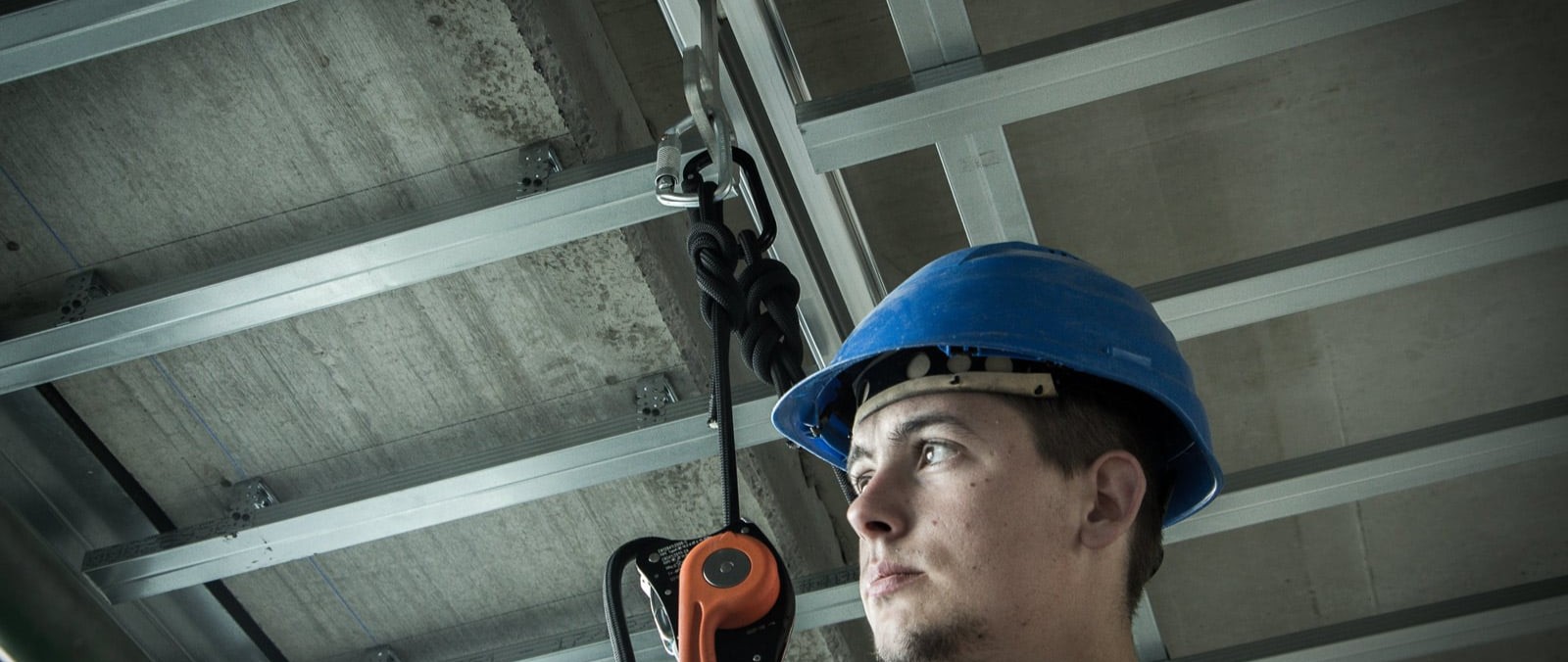
In Quebec, the regulation sets an order of priority among fall protection measures, and a lifeline only comes fourth, after modifying the work position, the guardrail and the safety net.
We say so because it is what guides our recommendations: where a walkway or a protected platform is achievable, that is the solution to choose. A lifeline takes over where collective protection cannot be installed: a roof visited rarely, a tower, a fixed ladder, an isolated maintenance station.
Which system for your situation?
The choice depends first on the direction of movement, then on the structure available to carry the system.

Restraint, fall arrest or suspension?
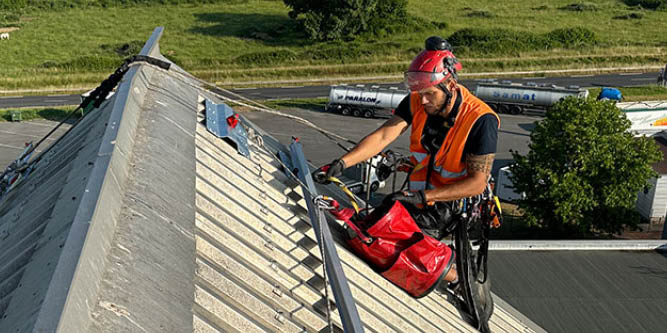
Before choosing a system, you have to define how the worker will use it. That is what determines the span, the number of users and the fall clearance required.
Restraint
The lanyard is set so that the worker cannot reach the edge. The fall is prevented rather than arrested: it is the safest mode wherever it is possible.
Fall arrest
The worker can reach the danger zone. The system must then arrest the fall, which calls for sufficient fall clearance below the work area.
Suspension
The worker hangs permanently from the system, for facade cleaning or maintenance. Only certain rail systems allow it.
Ten supports, as many interfaces
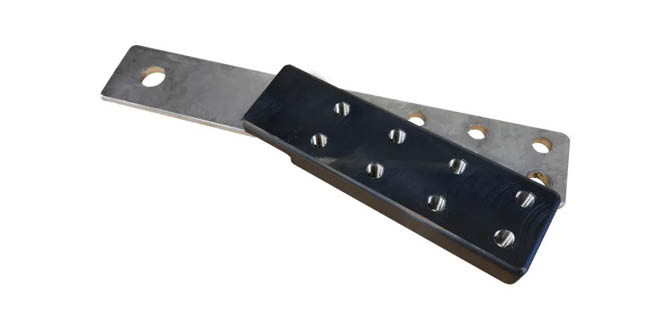
A lifeline is only worth the quality of its fixing. That is why the range includes an interface dedicated to each type of support, with its minimum thicknesses and compatible profile widths.
- Metal roofing: dry deck, aluminum deck, sealed deck, sandwich panel
- Traditional roofing: standing seam, zinc boarding, OSB panels
- Structures: steel frame, concrete slab, concrete wall
On top of each interface come the risers, tilting stanchions and articulations needed to cross a feature or make up a height difference. The support is verified during the site visit, before any sizing.
From study to verification
Free assessment
Analysis of the work areas, the access routes and the constraints of the support, on site.
Measurements and drawing
Routing of the line, position of the anchors, fall clearance calculation and engineering calculations. Drawing sealed by an engineer where the project calls for it.
Installation on site
Installation by our own teams, with identification of the points and handover of the documentation.
Periodic verification
Inspection of the system and of the associated personal protective equipment, return to compliance and documentary follow-up.
Standards and compliance
The horizontal lifelines in the CONEKT range are certified to EN 795:2012 and meet the requirements of Quebec's Regulation respecting occupational health and safety (RSST) and of the CSA Z259 series of standards.
Every installation comes with engineering calculations and a layout drawing. For custom systems, the reference is CSA Z259.16, which governs their engineered design. The drawing is sealed by an engineer licensed with the OIQ in Quebec or PEO in Ontario where the project calls for it. In Ontario, on a construction project, every horizontal lifeline must be designed by an engineer (O. Reg. 213/91).
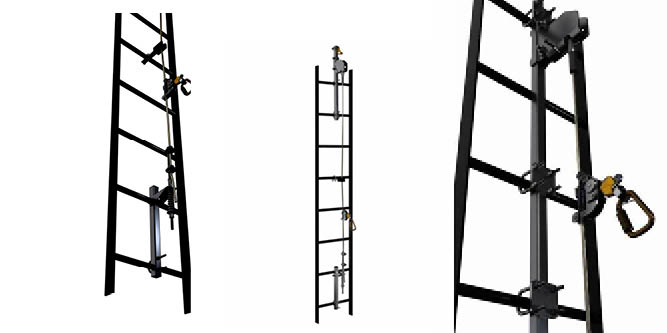
Lad-Saf vertical lifelines comply with CSA Z259.2.5, ANSI A14.3 and ANSI Z359.16, as well as OSHA regulations. MSA Latchways vertical lifelines comply with CSA Z259.2.5 when the kit is installed as described in the manufacturer's instructions, with the LadderLatch 3103L-00 climbing device.
Your questions about lifelines and anchors
Lifeline or guardrail: which one?
A guardrail wherever it is achievable: it protects everyone permanently, with no equipment to wear and no prior training. A lifeline takes over where collective protection cannot be installed. That is, in fact, the order the Quebec regulation sets out.
Cable or rail?
Cable covers long spans at a controlled cost, but it deflects under load. A rail does not deflect, which makes it indispensable where fall clearance is short, and it is the only one that allows suspended work.
How long a span without intermediate support?
Up to 15 m (49 ft) on most cable lines, and up to 56 m (184 ft) with CONEKT Ultra, designed for long spans with no intermediate pass-through. The span selected depends on the support and the configuration, and it is validated by the engineering calculations.
How many simultaneous users?
It depends on the system and on the applicable regulation. In Quebec, section 349 of the RSST limits a continuous flexible anchorage meeting the prescribed values to two workers, and section 348 reserves a vertical lifeline for one person. A system engineered to CSA Z259.16 may allow a different number, which is then stated on the plan and on the identification plate fitted to the line.
Can it be installed without piercing the roof?
Depending on the support and the configuration, yes. Some interfaces fix without perforating the roof membrane, and counterweighted anchors are simply ballasted into place. This point is settled during the site visit.
What is fall clearance?
It is the clear height needed below the work area for a fall to be arrested before the person reaches an obstacle or the floor. It depends on the system, the lanyard and the deflection of the line, and it forms part of the layout calculation.
Do lifelines have to be inspected?
Yes. The line and the associated personal protective equipment are subject to periodic verification, following the manufacturer's instructions. We handle that follow-up and the documentation that goes with it.
Do you work on existing installations?
Yes. We inspect lines already in place, identify non-conformities and propose repair or replacement.
The system is only as good as its three links
A perfectly sized lifeline protects no one if the worker is not properly equipped. Three elements have to work together.
The anchorage
The lifeline or the anchor point, sized for the support and for the intended number of users.
The connection
Energy-absorbing lanyard, twin-leg Y lanyard, self-retracting device or rope grab, chosen according to the actual movement and the fall clearance available.
The harness
Fitted to the person and the task: vest style, quick-connect, crossover for ladder climbing, or work positioning.
We distribute the HiiGARD range, designed and manufactured in Quebec by Sécurité Landry, a manufacturer in business for more than 80 years. Choosing a local manufacturer is not incidental: they work with the same regulatory realities as you do.


