

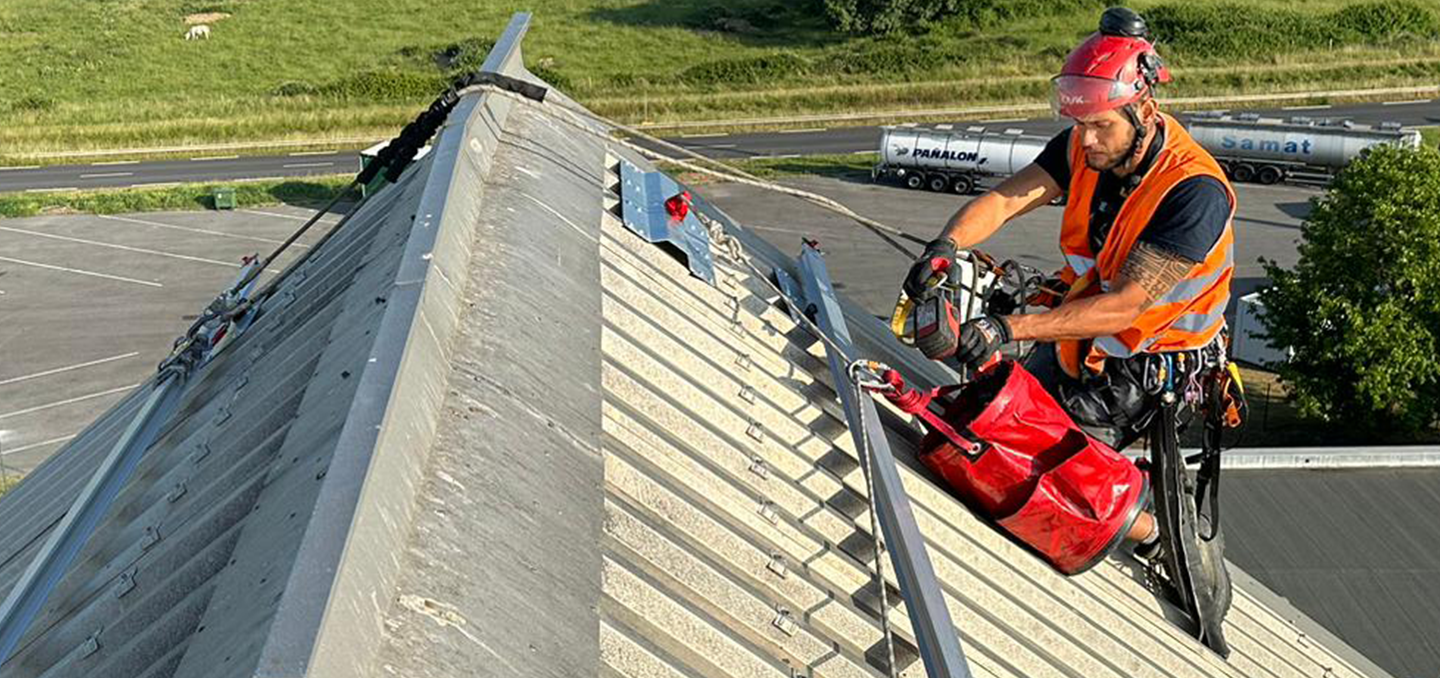
A rail answers the two situations a cable handles poorly: when there is not enough height below the worker for a flexible line to arrest a fall, and when the work is done in suspension. A rigid rail deflects little, so it stops short.
Everything else, span, number of users and support compatibility, follows the same logic as our horizontal cable lifelines. The three modes of work, restraint, work positioning and suspension, are defined there.
What a rail changes
Four differences from a cable line, one of which decides the matter on its own in most projects.
Deflection
This is the deciding criterion. Under a fall, a CONEKT PRO rail deflects by 50 cm (19.7 in), an ULTRA rail by 17 cm (6.7 in). A flexible line deforms considerably more.
Where fall clearance is short, under a walkway, beneath a low frame, above a machine, the rail is what makes it possible to actually arrest the fall before the floor.
Guidance
The trolley follows a continuous, rigid support. No pendulum effect, no slack: movement stays smooth over the whole length, including with several users.
Suspension
Rails allow suspended work, which no cable line permits apart from the ULTRA range.
Load distribution
In a fall, forces spread along the rail and its fixing points instead of concentrating on two end anchors. The impact on the supporting structure is correspondingly lower.
Two rail ranges
Mounting position separates them before anything else: the PRO rail goes anywhere, the ULTRA rail overhead only, where it becomes the higher performer of the two.

The most versatile
- Positions: floor, wall, overhead
- Work: restraint, work positioning
- Rail of 60 x 50 mm (2.4 x 2 in)
- R50, R52 or R53 trolleys
- Maximum span of 6 m (19 ft) on floor and wall, 4 m (13 ft) overhead
- Slope from 0 to 5°
- Deflection of 50 cm (19.7 in)
- Up to 4 people

The highest performer
- Positions: overhead
- Work: restraint, work positioning, suspension
- Rail of 60 x 120 mm (2.4 x 4.7 in)
- R52 or R53 trolleys
- Maximum span of 6 m (19 ft) in restraint, 5 m (16 ft) in suspension
- Slope from 0 to 5°
- Deflection of 17 cm (6.7 in)
- Up to 4 people
Both ranges meet the requirements of the RSST and the applicable CSA standards, and are certified to EN 795:2012 and CEN/TS 16415:2013 for simultaneous use by several people. What Quebec and Ontario require of a lifeline.
Fitting the building, not the reverse
The rail is fixed with base plates. It is the plate that changes from one support to another, not the system.
Every support
Steel deck, sealed deck, steel frame, timber, zinc, standing seam. Each support type has its dedicated plate.
Angle adjusted on site
The angle is set directly during installation, which allows the line to follow a frame that is never as regular as the drawing.
Removable or permanent trolleys
With opening end stops, trolleys are added or removed without dismantling the line. With fixed stops, they stay in place.
Installation is a short intervention, designed to limit downtime. Request a site survey.
Frequently asked questions
Rail or cable, how do you choose?
Three questions usually settle it. Is there enough clearance below the worker for a flexible line to arrest the fall before the floor? Is the work done in suspension? Is the area to cover long? Short fall clearance or suspended work points to a rail. A long run with few fixing points points to a cable, and our ULTRA range reaches 56 m (183 ft) with no intermediate anchor.
What is the maximum span between two fixings?
For the PRO rail, 6 m (19 ft) on floor and wall, 4 m (13 ft) overhead. For the ULTRA rail, 6 m (19 ft) in restraint and 5 m (16 ft) in suspension. That is the price of rigidity: a rail needs far more fixing points than a cable line. On an existing frame, this is what决 determines feasibility, and it is checked during the survey.
How many people can use it at the same time?
The system takes up to 4 people. In Quebec, the two-worker limit set by section 349 of the RSST applies to continuous flexible anchorages meeting the prescribed values, not to continuous rigid anchorages: those fall under an engineered design to CSA Z259.16, and the plan sets the number of simultaneous users.
Can you work in suspension on a rail?
Yes, with the ULTRA rail, installed overhead. The PRO rail covers restraint and work positioning, but not suspension. That is the main difference between the two ranges, ahead of dimensions.
Will a rail follow a sloped roof?
Within a narrow limit: 0 to 5°. The plate angle is adjusted during installation to follow the irregularities of a frame, but the admissible slope of the rail itself stays low. Beyond that, a cable line is the option to consider, our PRO range accepting up to 40°.
Does a rail lifeline require an engineer?
In Quebec, yes. Section 349 of the RSST provides that a continuous rigid anchorage system be engineered to CSA Z259.16. The supporting structure must also take the forces generated by the system on top of its usual loads, which means verifying it. See the Quebec and Ontario requirements.
Short fall clearance, a frame to verify, suspended work to secure? Talk it through with our technical team.


