

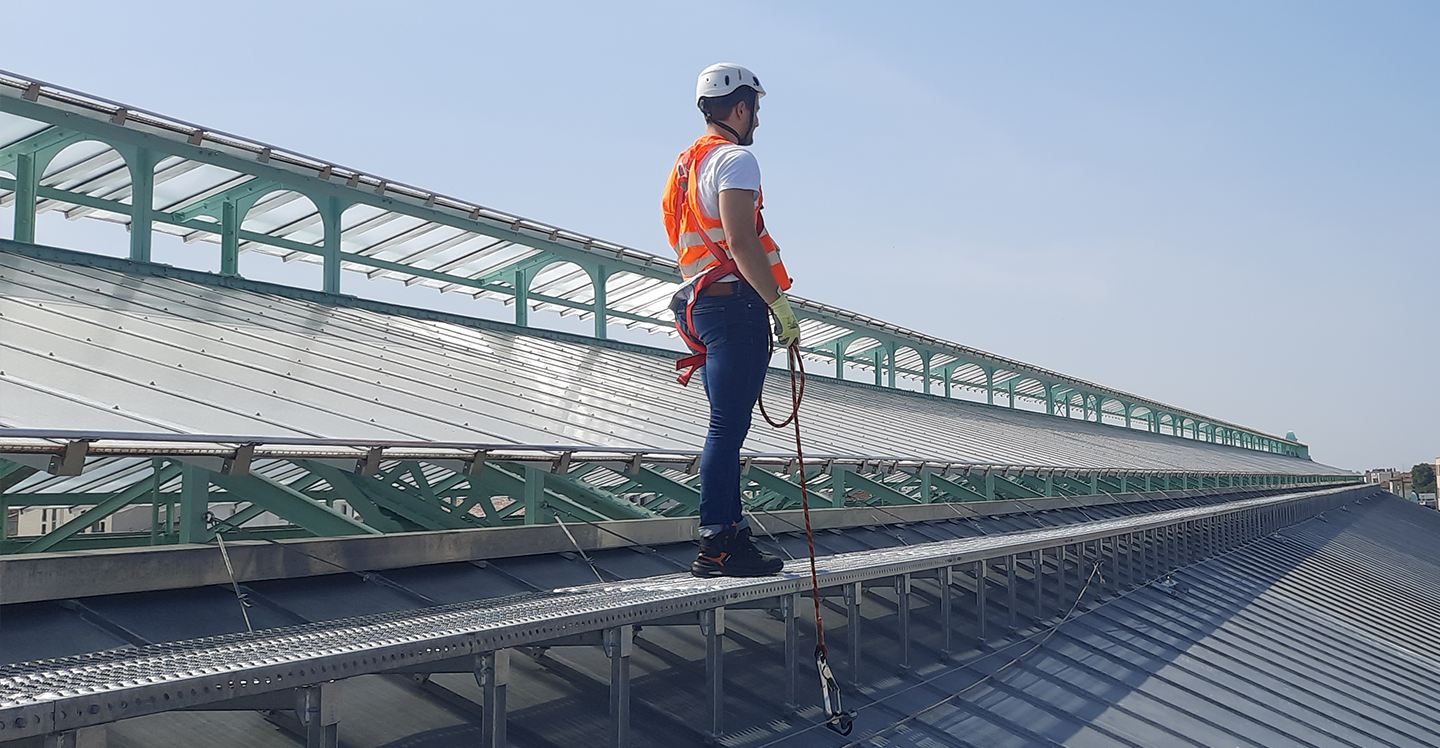
This is the most common way to secure movement on a roof. A cable tensioned between two anchors, intermediate points depending on the length, and a trolley or hook that follows the worker without them having to disconnect.
Where clearance is limited or the work is done in suspension, the rail lifeline is the right answer. To secure a climb, see the vertical lifeline. The full range is on our lifelines and anchors page.
Restraint, work positioning, suspension
Three modes of work, three levels of requirement. This is what decides the range, before span even comes up.
Restraint
The system stops the worker from reaching the fall zone. Correctly set, it makes a fall impossible. It is the only one of the three modes where the harness is there not to arrest a fall, but to make sure one never happens.
Work positioning
The worker leans back onto the system, which holds them in position and frees both hands. A fall remains possible: positioning is always paired with a fall arrest device.
Suspension
The worker hangs entirely from the system, with no support underfoot. This is the rope access mode. It calls for dedicated equipment and a rescue plan able to free a suspended person quickly.
Four ranges, four uses
All our horizontal cable lifelines share the same architecture. What sets them apart is the mounting position, the type of work allowed and the span.

The most economical
- Positions: floor, wall
- Work: restraint
- 8 mm (5/16 in) cable, standard connector
- Maximum span of 15 m (49 ft) on a rigid support, 12 m (39 ft) on roofing
- Slope from 0 to 15°
- Up to 3 people

The simplest
- Positions: floor, wall
- Work: restraint
- A single anchor type at the start, at the end and in between
- 8 mm (5/16 in) cable, span of 10 to 15 m (33 to 49 ft)
- Slope from 0 to 15°
- 3 people at one per span, or up to 3 on a single span with spacing limited to 10 m (32 ft)

The most versatile
- Positions: floor, wall, overhead
- Work: restraint, work positioning
- A single anchor type at the start, at the end and in between
- Slope up to 40°, crossings and branches possible
- 10 mm (3/8 in) cable, standard or OCHO PRO+ connector
- Maximum span of 15 m (49 ft), up to 5 people
- 316L stainless steel version for aggressive environments, with anchors that can be set in rock or soil

The longest spans
- Positions: floor, wall, overhead
- Work: restraint, work positioning (one user)
- From 10 to 56 m (33 to 184 ft) with no intermediate pass-through, in three versions
- 10 mm (3/8 in) cable, standard or OCHO PRO+ connector
- Slope from 0 to 15°
- Up to 3 people
Up to 56 m (184 ft) with no intermediate pass-through
The version is chosen according to the span to be covered, to cross long distances without any intermediate support.
CLASSIC and ESSENTIAL are restraint lines, on the floor or the wall. PRO and ULTRA go overhead and allow work positioning, limited to one user on ULTRA. Overhead, the PRO line assumes the OCHO PRO+ hook can be passed manually through the intermediate anchors, a point to check during the survey.
All four ranges are certified to EN 795:2012 and designed to meet the requirements of the RSST. What Quebec and Ontario require of a lifeline.
What it changes on site
On the PRO range, four design choices make a direct difference during installation and in daily use.
Six components
The system is deliberately compact. The cable is tensioned locally at each anchor, with M10 stainless fasteners and thread lock, with no complex tooling and no small parts to lose.
Permanent connection
There is no way to disconnect accidentally along the route. Double energy absorption, by sliding and by deformation, reduces the forces transmitted to your structure in the event of a fall.
Crossing without unhooking
The X-MATRIX branching cross lets two workers cross or overtake each other without detaching, and the RUPT system moves from a vertical plane to a horizontal one.
316L stainless version
For aggressive environments such as coastal and industrial sites, the PRO range comes in 316L stainless steel. The anchor can also be set directly in rock, and the line can be installed in soil.
Straight, angled, sloped
A lifeline rarely follows a perfect straight line. The configuration is built from the anchors, to match the route you actually need.
- Straight configuration: one cable and two end anchors
- Angled configuration: an extra anchor at the turning point, one being enough up to 40° and two beyond that, up to 90°
- Slopes up to 40°: on the PRO range, through hybridisation with the X-CONE system
- Positions: at floor level, wall mounted or overhead
Overhead, one point deserves attention: the hook passes through the intermediate anchors by hand, which we check during the study so the route stays practical to use.
Ten surfaces, ten interfaces
The stability of the line depends entirely on its fixings. Each type of surface has its own dedicated interface, with minimum thicknesses and compatible corrugation widths.
- Dry steel deck: at least 0.63 mm thick, corrugation widths from 200 to 500 mm depending on the plate
- Aluminum deck: at least 0.9 mm thick, corrugation widths of 250 and 333 mm or made to measure
- Sandwich panel: at least 0.5 mm thick
- Waterproofed deck: toggle bolt fixing, installed directly onto the waterproofing system with no work from below
- OSB or chipboard panels: at least 18 mm thick
- Zinc battens: battens of at least 12 mm
- Standing seam: seam spacing from 290 to 430 mm, or from 460 to 600 mm depending on the interface
- Steel frame: double clamp gripping a flange from 3 to 25 mm thick
- Concrete slab: rigid posts of 500, 700 or 1000 mm, or stainless posts of 150 and 300 mm
- Concrete wall: 2-point plate for poured concrete, 4-point plate for other masonry
Risers and tilting posts complete the assembly where a feature has to be cleared or a height made up. The surface is checked during the survey, before any sizing.
Standards and compliance
CONEKT lifelines are certified to EN 795:2012 and designed to meet the requirements of the Regulation respecting occupational health and safety. Every installation comes with design notes and a layout drawing, and with a drawing sealed by an engineer where the project requires it.
On handover, the line receives its identification plate stating the number of simultaneous users allowed, and you receive the installation documentation.
Your questions about cable lifelines
What is the maximum span between two anchors?
15 m (49 ft) on most of the range, and up to 56 m (184 ft) with no intermediate point on the ULTRA version. On roofing, the span of the CLASSIC range drops to 12 m (39 ft).
How many people can use it at the same time?
It depends on the range, the configuration and the applicable regulation. In Quebec, section 349 of the RSST limits a continuous flexible anchorage meeting the prescribed values to two workers. A line engineered to CSA Z259.16 may allow a different number, which is then stated on the plan and on the identification plate fitted to the line.
Can it be installed on a sloped roof?
Up to 15° on the CLASSIC, ESSENTIAL and ULTRA ranges, and up to 40° on the PRO range, through hybridisation with the X-CONE system.
Can two workers cross paths on the line?
On the PRO range, yes. The X-MATRIX branching cross lets them cross or overtake each other without detaching from the line.
Does the waterproofing have to be pierced?
Not necessarily. On a waterproofed deck, the interface fixes with toggle bolts directly onto the waterproofing system, with no work from below. The fixing method is settled during the survey, based on your roof covering.
What is cable sag?
It is how far the cable drops under load in the event of a fall. It adds to the fall height and therefore enters into the clearance calculation. Where the free height below is insufficient, a rail line is the right choice.
Does the line have to be inspected?
Yes. The line and the associated personal protective equipment are subject to periodic inspection, in line with the manufacturer's instructions. We handle that follow-up and the related documentation.


