

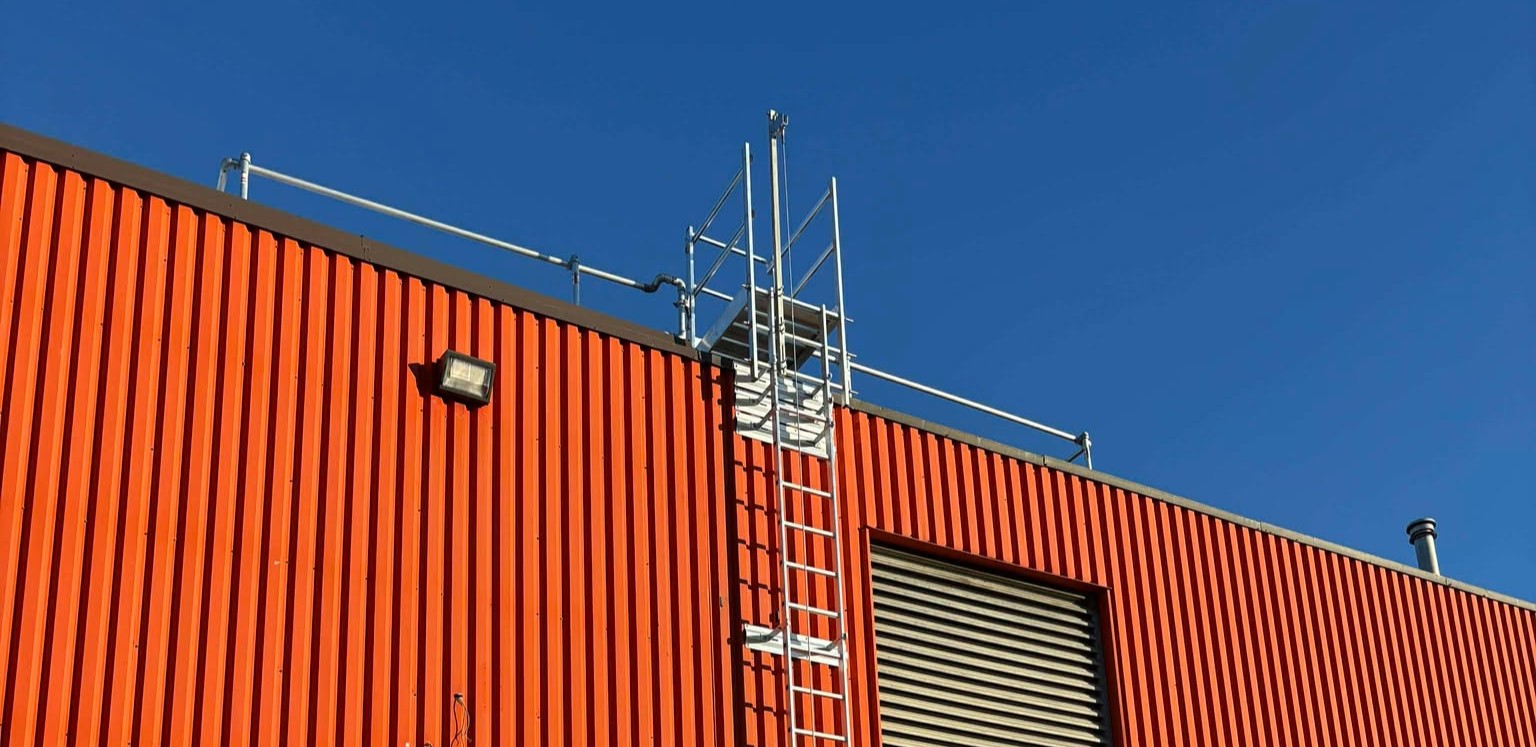
A vertical lifeline protects the climb. The climber stays connected to the cable from the first rung to the last, and the climbing device locks instantly if a foot slips.
It is the solution Quebec has required since 2019 on new or modified fixed ladders where the fall exceeds 6 m (19 ft 8 in), and the one that protects the climb in Ontario on structures where a cage is not used. See fixed ladders in Quebec and in Ontario.
Two systems: Lad-Saf by 3M and MSA Latchways
We offer two cable vertical lifelines. The principle is the same: the climber is connected to the cable by a climbing device that follows them with no handling and locks in the event of a fall. The choice depends on the ladder, the exit at the top and the structure.
Lad-Saf
Brackets: a top bracket and a bottom bracket, fixed to the ladder rungs or directly to the structure. The top bracket includes the anchorage point, rated at 3,600 lb (16,018 N).
Cable: 9.5 mm (3/8 in) steel cable, pre-swaged, ordered to the length of the ladder. An intermediate bracket is recommended every 6 to 12 m (20 to 39 ft).
Climbing device: Lad-Saf X2 or X3, connected to the sternal attachment point of a harness compliant with CSA Z259.10.
Key features: four configurations, from roof hatches to towers. The new generation of brackets has fewer than 13 separate components, compared with more than three times as many on previous models.
MSA Latchways
Complete kit: supplied with all fixings, in ten lengths from 3 to 55 m (10 to 180 ft). The cable is adjusted on site to the actual height of the ladder.
Cable: 8 mm (5/16 in) 316 stainless steel, like the ladder-mounted components. The galvanized steel top anchor withstands more than 22 kN (5,000 lb). The system is suitable for indoor and outdoor use.
Energy absorber: fitted at the top of the line, it limits the arrest force to less than 6 kN (1,350 lb).
Climbing device: LadderLatch, the only device approved for this system.
In both cases, protection also depends on the climber's harness. See our personal protective equipment.
Five configurations to suit your ladder
What sets the configurations apart is how the line attaches to your structure, and how far up it keeps the climber protected.
Rung mounting
The standard configuration, on an existing fixed ladder. The brackets attach directly to the rungs.
Lad-Saf: round, square, diamond, angle and rectangular rungs, with galvanized steel brackets. MSA: round, square and diamond rungs on steel fixed ladders, with rung spacing from 225 to 305 mm (8.86 to 12 in).
Extension post
The anchorage point sits at the top of a post clamped to the upper rungs, so the cable extends above the top of the ladder.
Climbers step onto the roof or platform while still attached. The post comes in galvanized steel, or in stainless steel for 6 m (20 ft) and 12 m (40 ft) ladders.
Fixed 4 ft extension
The top bracket extends protection 4 ft (1.22 m) above the top of the ladder, with an 86.5 in (2.20 m) arm.
For exits where climbers must stay protected above the top rung, with no adjustable mechanism.
Telescoping extension for roof hatches
A 76 cm (30 in) telescoping arm extends through the roof hatch. Protection stays continuous as the climber exits onto the roof, which is the most exposed moment of the climb.
Pole mounting
For tubular structures without rungs: telecommunication masts, towers and utility poles. Dedicated top and bottom brackets, with a built-in energy absorber and tension indicator.
Available in galvanized or stainless steel.
Standards the systems meet
A vertical lifeline is the only fall arrest equipment that Quebec's regulation explicitly names for fixed ladders. Here are the standards involved.
CSA Z259.2.5
Section 348 of the RSST requires the climbing device and the vertical lifeline to comply with CSA Z259.2.5, or with CSA Z259.2.4 for a rigid rail. Section 23 requires this device on new or modified fixed ladders where the fall exceeds 6 m (19 ft 8 in).
The Lad-Saf system declares compliance with CSA Z259.2.5. For MSA Latchways, CSA Z259.2.5 compliance covers the kit installed as described in the manufacturer's instructions, with the LadderLatch 3103L-00 climbing device.
ANSI and OSHA
The Lad-Saf system also declares compliance with ANSI A14.3, which covers fixed ladders, and its components with ANSI Z359.16, the design standard for ladder fall arrest systems. OSHA regulations 1910.140 and 1926.502 are covered.
The structure carrying the line must withstand the loads the system transfers to it, in addition to its usual loads. This is a requirement of section 349.1 of the RSST, and it is what we check during the site survey on an existing ladder. For reference, CSA Z259.2.5 sets a maximum arrest load of 8 kN (1,800 lb). See what Quebec and Ontario require of a lifeline.
Installation is restricted to trained personnel.
Frequently asked questions
Lifeline or cage on a fixed ladder?
It depends on the province. In Quebec, since January 3, 2019, section 23 of the RSST names two options above 6 m (19 ft 8 in) on a new or modified ladder, a flexible vertical lifeline or a rigid rail, and rules out the cage. In Ontario, Regulation 851 keeps the cage as the default solution above 5 m (16 ft), with a lifeline replacing it only on certain structures. See fixed ladders in Quebec and in Ontario.
Lad-Saf or MSA Latchways: which one?
Both protect the climb in the same way. The choice depends on the ladder, the exit at the top and the structure: MSA Latchways fits steel fixed ladders, with an extension post so climbers can step off while still attached; Lad-Saf also covers roof hatch access and structures without rungs, such as towers. We decide during the site survey.
Can an existing fixed ladder be equipped?
Yes, it is the most common case. The brackets attach to the rungs: round, square, diamond, angle or rectangular for Lad-Saf, and round, square or diamond for MSA Latchways. The point to check is therefore not bracket compatibility, but whether the ladder and its anchorage can withstand the loads from the system.
Does the climbing device need handling during the climb?
No. The climbing device follows the climber up and down with no intervention, and locks automatically in the event of a fall. That is what sets a vertical lifeline apart from a simple anchor point: protection is continuous, and there is never a moment when the worker has to disconnect.
How high can it go?
Section 348 of the RSST requires a vertical lifeline shorter than 90 m (295 ft). MSA Latchways kits cover ladders from 3 to 55 m (10 to 180 ft). Intermediate guides hold the cable and limit its movement: every 6 to 12 m (20 to 39 ft) on Lad-Saf, and no more than 4 m (13 ft) apart on MSA Latchways, reduced to 3 m (10 ft) where the site reference wind speed exceeds 30 m/s (67 mph).
What about the exit at the top of the ladder?
It is the most exposed moment of the climb, and the one a line ending at the top rung leaves unprotected. Three configurations deal with it: the MSA Latchways extension post, which places the anchorage above the top of the ladder; the Lad-Saf fixed extension, which extends the anchorage 4 ft (1.22 m); and the Lad-Saf telescoping extension, whose 76 cm (30 in) arm extends through a roof hatch.
Who can install the system?
Trained personnel only, following the manufacturer's instructions. For MSA Latchways, installation is restricted to a competent person trained on its systems, and the kit is installed as supplied, with no part added or substituted. The supporting structure must also be checked, as required by section 349.1 of the RSST. Our teams handle the site survey, supply and installation.
A fixed ladder to bring into compliance, a structure to check? Talk to our technical team.


