

The regulatory framework: two regulations depending on context
In Ontario, a fixed ladder installed in an industrial establishment is governed by Regulation 851 (R.R.O. 1990, Industrial Establishments), notably sections 18 and 19. On a construction site, Ontario Regulation 213/91 (Construction Projects), sections 78 to 84, applies instead.
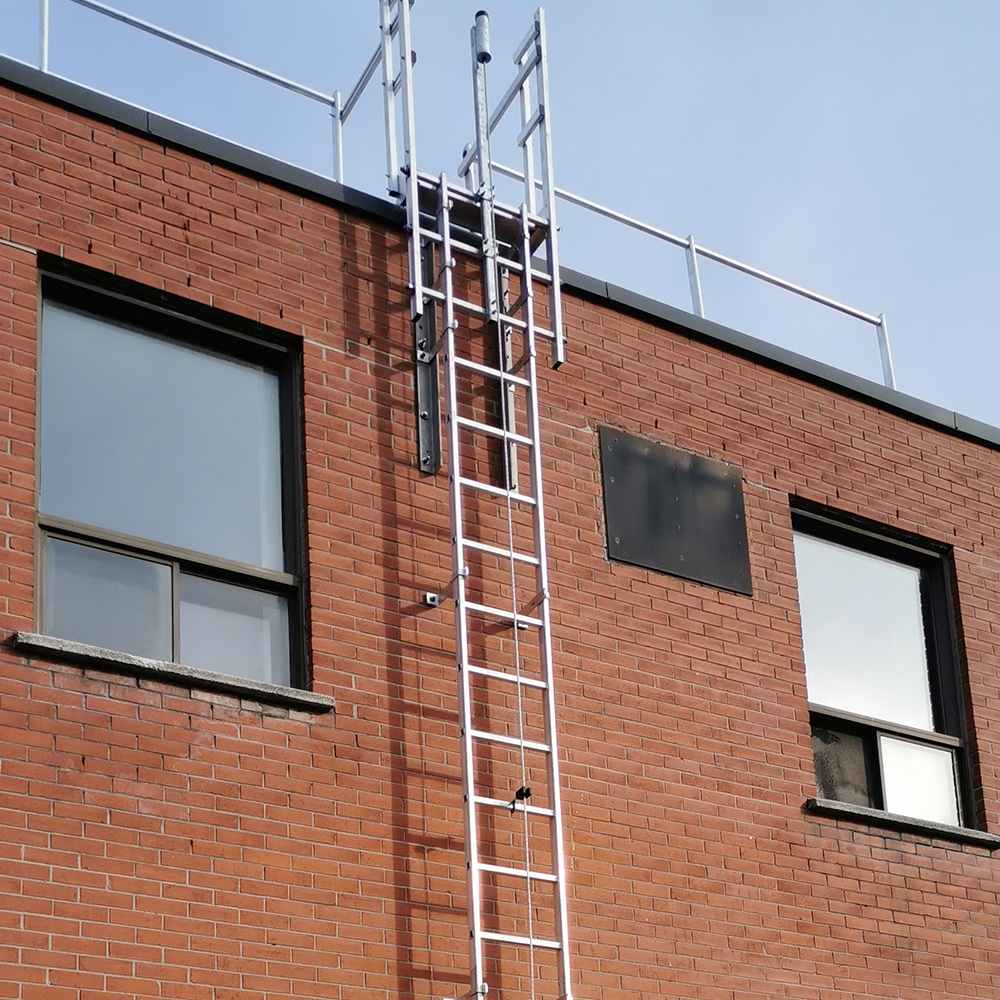
Design requirements (Regulation 851, section 18)
A fixed access ladder must be vertical and have rest platforms at intervals of not more than 9 m (30 ft), with the ladder offset at each rest platform.
Where it extends over 5 m (16 ft), it must have a safety cage. The cage must begin no more than 2.2 m (7 ft) above grade, floor, or landing, and continue at least 90 cm (35 in) above the top landing, with openings to permit access to the rest platforms or the top landing.
The ladder's side rails must extend 90 cm (35 in) above the landing, and the rungs must be located at least 15 cm (6 in) from the wall, spaced at regular intervals.
These requirements do not apply to an access ladder on a tower, water tank, chimney or similar structure that is fitted with a safety device protecting a worker who falls (section 18, subsection 2).
Access to elevated equipment (section 19)
Where frequent access is required to equipment located above or below floor level, permanent platforms must be served by a fixed stair or a fixed access ladder.
Quebec and Ontario: two different thresholds
The threshold above which fall protection is required differs between provinces: 5 m (16 ft) in Ontario versus 6 m (20 ft) in Quebec.
Requirements summary (Regulation 851)
Vertical ladder with rest platforms at not more than 9 m (30 ft) intervals and an offset at each platform; safety cage required beyond 5 m (16 ft), beginning no more than 2.2 m (7 ft) above grade and continuing at least 90 cm (35 in) above the top landing; side rails extending 90 cm (35 in) above the landing; rungs at least 15 cm (6 in) from the wall. Only exception: ladders on a tower, water tank, chimney or similar structure fitted with a safety device.
| Requirement (Regulation 851, s. 18) | Value |
|---|---|
| Ladder orientation | vertical |
| Rest platforms | every 9 m (30 ft) maximum, with the ladder offset at each platform |
| Safety cage threshold | required if ladder > 5 m (16 ft) |
| Cage start point | 2.2 m (7 ft) maximum above grade |
| Cage overrun | 90 cm (35 in) minimum above top landing |
| Side rail overrun | 90 cm (35 in) above landing |
| Rung clearance | 15 cm (6 in) minimum from wall |
| Exception (s. 18(2)) | towers, water tanks, chimneys and similar structures fitted with a safety device |
| Applicable regulation (industrial) | Regulation 851 (R.R.O. 1990) |
| Applicable regulation (construction) | Ontario Regulation 213/91, s. 78-84 |
Why choose Échelle Canada
Échelle Canada designs every Fixup fixed ladder to measure, based on the actual height of the building, machine, or maintenance area it serves. Fully manufactured in aluminum, welding-free, it assembles quickly on site from a small number of base parts (ladder sections, hoops, mounting brackets), with all hardware delivered pre-fitted.
Our advisors work with you, based on the height of your installation and the applicable regulation (industrial establishment or construction site), to determine whether a safety cage or a fall arrest device is required, and build the appropriate solution into the design from the start.
Frequently asked questions
At what height must a fixed ladder in Ontario have a safety cage?
Where it extends over 5 m (16 ft) above grade, under section 18 of Regulation 851, unless a device providing equivalent protection is fitted.
How does this differ from Quebec's requirements?
The threshold differs (5 m / 16 ft in Ontario versus 6 m / 20 ft in Quebec).
Does this regulation also apply to construction sites?
No. Regulation 851 applies to industrial establishments. Construction sites fall under Ontario Regulation 213/91, which has its own provisions on ladders (sections 78 to 84).