

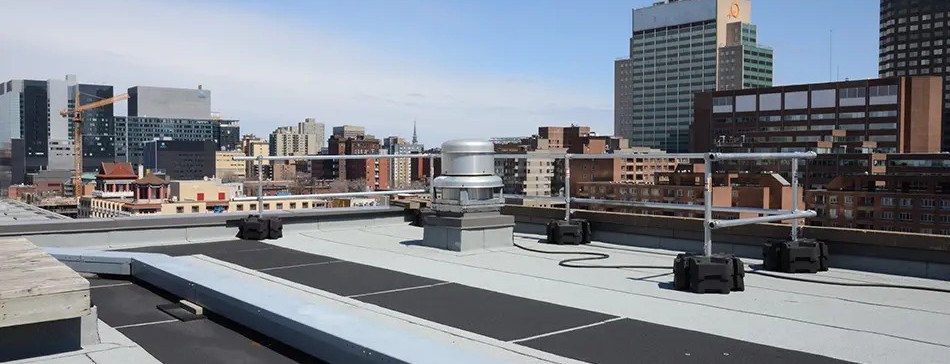
A guardrail ranks second in the hierarchy of prevention measures, just after eliminating the risk and well ahead of a harness. The reason is simple: it protects everyone permanently, with no equipment to wear, no prior training, and without depending on anyone's vigilance.
It is therefore the first solution to consider on a roof, and the one we recommend wherever it is achievable. Why a guardrail comes before a harness ›
Three answers, depending on what you protect
A roof perimeter, an access point, or a temporary work area: these are not the same needs, nor the same solutions.
Freestanding (non-penetrating) guardrail
Permanent protection of a roof edge, held by ballast, with no penetration of the roof membrane.
Roof hatch guardrail
Securing the most exposed moment, the exit onto the roof, with a gate that closes the opening behind the worker.
Warning line
Marking out a work area away from the edge. Note that its use is tightly regulated, with rules specific to each province.
Freestanding (non-penetrating) guardrails
An all-aluminum system, held by ballasted bases that rest directly on the roof membrane. Nothing goes through the membrane.
The roof membrane stays intact
This is the argument that settles most projects. Ballasting avoids any drilling, and therefore any membrane repair, any roofer's intervention and any risk of leaks later on. Installation needs neither welding nor drilling.
Straight or raked at 25°
The post comes in a straight version or raked at 25°, pre-assembled in the workshop. The rake sets the rail back from the edge, which makes it less visible from the ground, a point that matters on a building whose outline you would rather not change.
Stackable or linear
The stackable version stacks the bases and takes a timber or aluminum toe board directly in their slots. The linear version covers long perimeters and copes with slightly sloped roofs.
Aluminum and galvanized steel
Continuous rectangular aluminum rail, rubber or concrete bases, galvanized steel bracing. The assembly resists corrosion and needs no maintenance.
On a concrete parapet, fixing with a single M12 anchor is also possible, with engineering calculations according to the configuration. The choice between ballast and fixing is made during the site visit, based on the support and on wind exposure.
Roof hatch guardrails
Climbing out of a hatch is the most exposed moment of a roof intervention: the worker emerges with both hands busy, back to an open hole. A hatch guardrail addresses that precise moment.
The opening closes again
A retractable gate, extending from 32 to 46 in (81 to 117 cm) in a high-visibility colour, closes the access behind the worker. The opening is never left clear during the job.
Two fixing methods
By compression, using a threaded rod and galvanized steel nuts, with no perforation of the roof. Or by anchoring, with screws into the hatch's metal flashing, for a permanent installation.
Aluminum or galvanized steel
Posts in 6061-T6 aluminum or galvanized steel, 1.9 in (48 mm) outside diameter. Fittings and support structure in galvanized steel.
The same principle applies to skylights, whose domes are not designed to hold a person. Here too the protection is permanent, and independent of the worker's own equipment.
Warning lines in Quebec: what the RSST actually allows
A warning line arrests no fall. It marks out a work area away from the edge, and the Quebec regulation frames very precisely the cases where it may replace a guardrail.
Two conditions, not one less
A warning line may replace a guardrail only where the work is roofing work, and where the roof slope is 15° or less, that is 3/12.
Outside the delimited area, another recognised means remains mandatory, in particular a harness tied to an anchorage system in accordance with section 347.
The required characteristics
- Placed 2 m (6.6 ft) or more from any point where a worker could fall
- Height between 0.7 m (27.6 in) and 1.2 m (47.2 in)
- Rigid band, cable or chain withstanding a tensile force of at least 2.22 kN, and supporting a 100 N load applied horizontally
- High-visibility flags spaced no more than 2 m (6.5 ft) apart
- Stanchions spaced no more than 2.5 m (8.2 ft) apart
- Continuous on all sides of the delimited area
- At roof accesses, a guardrail additionally covers the first 3 metres (9.8 ft)
These values are not recommendations, they are the characteristics the RSST imposes. Compliance of a warning line is decided by its layout on site far more than by the product itself: we set it out during the site visit, based on the actual geometry of the roof and its access points.
In Ontario, warning lines are subject to different rules. For an Ontario project, our technical team will tell you which requirements apply.
What Quebec and Ontario require
RSST and CSA A500
Section 12 of the RSST requires a permanent guardrail to meet the requirements of the National Building Code in force at the time of its installation. The CSA A500 standard governs the design of building guards, from height to load resistance.
Regulation 851
Section 13 sets out where a guardrail is required around openings and elevated surfaces. Section 14 describes its construction, with a top rail located between 91 and 107 cm (36 to 42 in) above the surface, and compliance with Building Code requirements.
A guardrail ranks second in the hierarchy of prevention measures, ahead of the safety net and the harness. Understanding the hierarchy of prevention measures ›
Frequently asked questions
Guardrail or lifeline?
A guardrail wherever it is achievable. It protects everyone permanently, with no equipment to wear, no prior training and without depending on anyone's vigilance. A lifeline takes over where collective protection cannot be installed. That is the order the regulation sets, not a commercial preference. See our lifelines and anchors.
Does the roof membrane have to be pierced?
No, in the great majority of cases. A freestanding (non-penetrating) guardrail is held by ballast, its bases resting directly on the membrane. On a concrete parapet, mechanical fixing remains possible where the configuration calls for it. The choice is made during the site visit, based on the support and on wind exposure.
Does a warning line replace a guardrail?
In Quebec, only under two conditions together, set by section 33.5 of the RSST: the work must be roofing work, and the roof slope must be 15° or less, that is 3/12. And even then, outside the delimited area another recognised means remains mandatory, in particular a harness tied to an anchor. In Ontario, the rules are different. In all cases, a warning line arrests no fall.
At what height should the top rail sit?
In Quebec, a permanent guardrail must meet the requirements of the National Building Code in force at the time of its installation, and the CSA A500 standard governs its design. In Ontario, section 14 of Regulation 851 places the top rail between 91 and 107 cm (36 to 42 in) above the surface.
What about the roof hatch?
It is the most frequently forgotten point. The worker climbs out with both hands busy, back to an opening. A hatch guardrail with a gate closes the access behind them. Note as well: in Quebec, where a warning line is used, section 354.1 of the RSST requires a guardrail to additionally cover the first three metres at roof accesses.
Do skylights count?
Yes. A skylight dome is not designed to hold a person, and should never be treated as a walkable surface. It is protected like an opening, with a guardrail or a dedicated protection.
A roof to secure, a hatch to equip? Talk it through with our technical team.


