

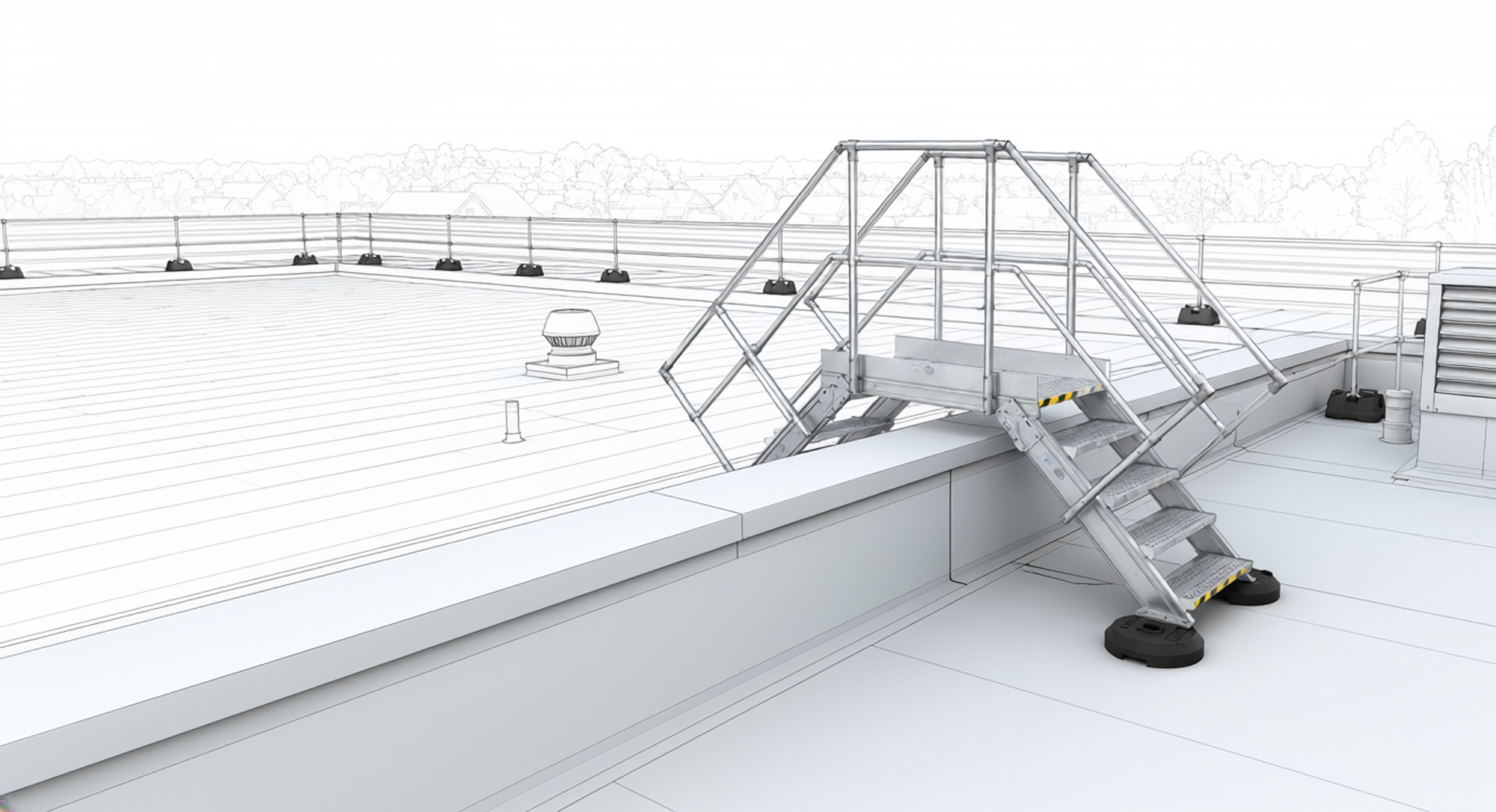
On a technical roof or in a workshop, a low obstacle is rarely crossed safely: people step over it, walk around it, or lean on something that was never meant to take the weight. A crossover walkway creates a protected route over the obstacle, and marks out the authorized path at the same time.
To link two distant points rather than cross a single obstacle, see our access walkways. To climb a level, see our industrial stairs. The full range is on our custom height access page.
What needs crossing?
The height and width of the obstacle determine the configuration of the walkway.
Ducts and pipe runs
Rooftop technical networks, ventilation ducts and pipework that cut across a maintenance route.
Low walls and parapets
Waterproofing upstands, dividing walls and parapets between two roof areas that need linking.
Expansion joints
Crossings between two parts of a building, to be spanned without bearing on the joint itself.
Machines and conveyors
Access from one side of a production line to the other, without walking around it or climbing over the equipment.
Two models to suit your configuration
The pre-assembled walkway
Delivered pre-assembled with its removable guardrail, which simplifies handling up to the roof. LEEVELGRIP decking is fitted as standard.
- Inclines of 45 or 60°
- Guardrail removable if needed
- Non-slip, draining LEEVELGRIP decking
The modular walkway
Made up of four separate modules, climbing flights, platform, guardrail and rails, it is configured step by step to suit the height to be crossed.
- From 1 to 7 steps, as required
- Platform of 800 mm (31.5 in) or 1400 mm (55 in)
- Asymmetric configuration available between the two climbing flights
The asymmetric configuration allows an obstacle to be crossed between two different levels, with a different number of steps on each side.
Without drilling into your building
On a roof, every perforation is a potential weak point for the waterproofing. Our crossover walkways stabilise on resin pads, bearing on the existing surface, with no anchoring and no drilling through the membrane.
You keep the integrity of your waterproofing system and the warranties attached to it, while creating a permanent crossing. The walkway also remains removable and repositionable if your installation changes.
Where the configuration calls for it, anchored fixing remains possible: the choice is made during the survey, based on the surface and wind exposure.
Specifications
- Structure: aluminum, bolted assembly
- Steps and platform: heavily non-slip striped aluminum, or optional LEEVELGRIP non-slip, draining decking
- Other decking: grating on request
- Inclines: 45 or 60°, depending on the space available at the foot of the obstacle
- Number of steps: 1 to 7 per climbing flight
- Platform: 800 mm (31.5 in) or 1400 mm (55 in) long
- Stabilisation: freestanding resin pads, no drilling
- Guardrails: fitted as standard, removable if needed
Guardrails and regulations
A crossover walkway raises the user above the walking surface, onto a platform and steps. Guardrails are therefore an integral part of the equipment, and they are what allows the obstacle to be crossed without personal fall protection.
Your questions about crossover walkways
Does the roof have to be drilled to install it?
No, in most cases. The walkway stabilises on resin pads resting on the existing surface, with no anchoring and no drilling through the waterproofing membrane. Anchored fixing remains possible where the configuration requires it.
How high an obstacle can you cross?
From 1 to 7 steps per climbing flight, which covers the vast majority of technical obstacles. The exact height is determined during the survey, based on the obstacle and the space available on each side.
Can you cross between two different levels?
Yes. The asymmetric configuration allows a different number of steps on each side of the platform, which serves to link two roof areas or two floors at different heights.
Is a harness needed to use it?
The walkway is fitted with guardrails, which protect the user during the crossing without requiring personal fall arrest equipment.
Can the walkway be dismantled?
Yes. Bolted assembly and pad stabilisation mean it can be taken apart and repositioned if your installations change.
Is the decking suitable for outdoor use?
Yes. Striped aluminum is heavily non-slip, and the optional LEEVELGRIP decking is also draining, which prevents water from pooling on the steps and platform.


