

What the CSA Z259.2.5 standard applies to
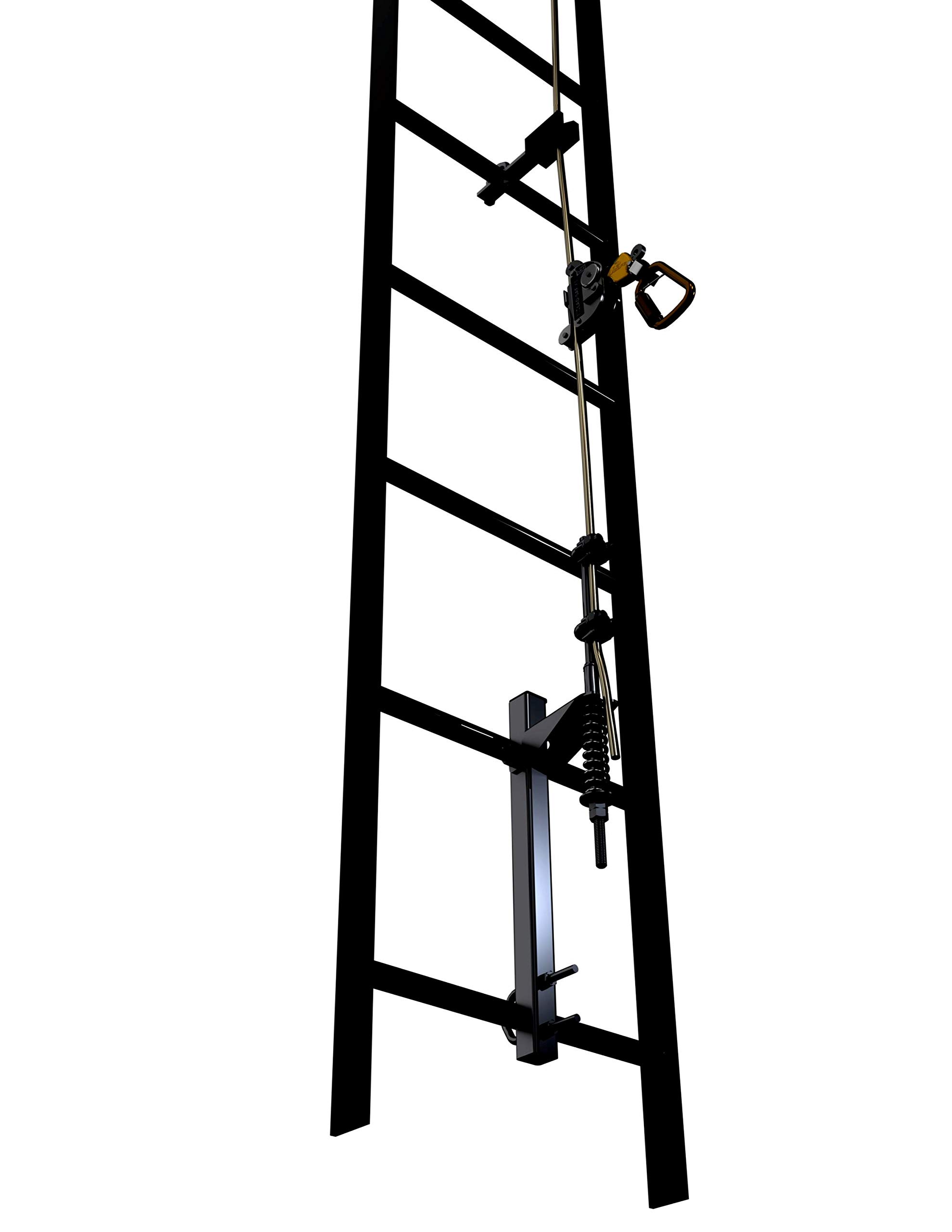
The CSA Z259.2.5 standard covers fall arresters and vertical lifelines installed on fixed ladders, that is, the permanent vertical ladders found on silos, telecommunication towers, chimneys, tanks and industrial buildings.
- Anchor brackets: mounted at the top and bottom of the ladder.
- Safety cable or rail: the vertical lifeline the user travels along.
- Sleeve or fall arrester: locks automatically in the event of a fall.
The standard does not apply to full body harnesses (CSA Z259.10), lanyards and energy absorbers (CSA Z259.11), or systems custom designed for specific applications, covered by CSA Z259.16, not to be confused with the American ANSI Z359.16 standard, which shares a similar name but a different scope.
Technical requirements of the CSA Z259.2.5 standard
| Characteristic | CSA Z259.2.5-17 Requirement |
|---|---|
| Maximum average arrest force | 6 kN (dynamic testing) |
| Maximum permissible arrest force | 8 kN (dynamic testing) |
| Maximum arrest distance | 1 m |
| Maximum length of the lanyard connected to the sleeve | 750 mm (0.75 m) |
These requirements are intended to limit the forces transmitted to the user's body as well as the free fall distance before complete arrest.
Regulatory requirements in Quebec and Canada
Since January 3, 2019, protective cages are no longer accepted on new or modified fixed ladders in Quebec for any fall height greater than 6 m. A fall arrester compliant with CSA Z259.2.5, or a rigid rail compliant with CSA Z259.2.4, is now required instead.
This requirement stems from section 23 of Quebec's Regulation respecting occupational health and safety (RSST). Selling a fixed ladder equipped only with a cage as a compliant solution for a new installation in Quebec constitutes a regulatory non compliance.
CSA Z259.2.5 and ANSI Z359.16: which standard for the Canadian market
In Canada, vertical cable lifeline systems on fixed ladders must meet the CSA Z259.2.5 standard. In the United States, the equivalent standard is ANSI Z359.16.
Important: do not confuse the American ANSI Z359.16 standard with the Canadian CSA Z259.16 standard, which shares a similar name but a different scope. The latter governs the design of custom active fall protection systems, not standard manufactured devices for fixed ladders.
Most North American manufacturers seek both certifications, but this is not universal. Always verify explicit CSA Z259.2.5 compliance before installing a system in Canada.
The CSA Z259 series: the fall protection standards ecosystem
The CSA Z259.2.5 standard is part of a broad series of standards published by CSA Group, each covering a component of a fall protection system.
| Standard | Component Covered |
|---|---|
| CSA Z259.10 | Full body harnesses |
| CSA Z259.11 | Lanyards and energy absorbers |
| CSA Z259.12 | Connectors (carabiners, snap hooks) |
| CSA Z259.13 | Manufactured horizontal lifeline systems |
| CSA Z259.15 | Anchorage connectors |
| CSA Z259.16 | Design of custom active fall protection systems |
| CSA Z259.2.2 | Self-retracting devices |
| CSA Z259.2.5 | Fall arresters for fixed ladders (this page) |
Our products compliant with the CSA Z259.2.5 standard
The MSA Latchways LadderLatch system (ref. 3103L-00) is certified compliant with the CSA Z259.2.5-12 standard, as well as the ANSI Z359.1 and European EN 353:1 standards.
The 3M DBI-SALA Lad-Saf system (rung mount 6116631, climb extension 6116636, telescoping extension 6116618) is certified compliant with the ANSI Z359.16 standard. [TO BE CONFIRMED] Compliance with the CSA Z259.2.5 standard should be confirmed with 3M Canada before any installation requiring this specific certification in Canada.
Frequently asked questions about the CSA Z259.2.5 standard
Are cages completely banned in Quebec?
No, not on existing, unmodified fixed ladders. The ban applies to fixed ladders that are new or modified since January 3, 2019, for fall heights greater than 6 m. A device compliant with CSA Z259.2.5 or a rigid rail compliant with CSA Z259.2.4 is now required for these installations.
What is the maximum arrest force allowed under the standard?
The standard sets a maximum average arrest force of 6 kN and a maximum permissible arrest force of 8 kN during dynamic testing.
What is the difference between CSA Z259.2.5 and CSA Z259.16?
Despite the similar numbering, these are two different standards. CSA Z259.2.5 governs standard manufactured devices for fixed ladders. CSA Z259.16 governs the design of custom active fall protection systems. Also do not confuse the Canadian CSA Z259.16 with the American ANSI Z359.16, which corresponds to fixed ladder systems like CSA Z259.2.5.
Is a product certified to ANSI Z359.16 automatically compliant with CSA Z259.2.5?
Not necessarily. The two standards are close but distinct. Always verify explicit CSA Z259.2.5 certification with the manufacturer before an installation in Canada.
What is the maximum length of the lanyard connected to the sleeve?
The standard limits this lanyard to 750 mm (0.75 m) to reduce the free fall distance before arrest.