

What the CSA Z11 standard applies to
The CSA Z11 standard covers all portable ladders for professional and household use manufactured or sold in Canada, regardless of material.
- Stepladders: single sided stepladders, twin sided stepladders, platform stepladders and articulated stepladders.
- Straight ladders: single ladders leaned against a wall or structure.
- Extension ladders: sliding ladders with one or two sections.
- Combination ladders: ladders that can be used in multiple configurations.
The standard sets requirements for structural design, acceptable materials (aluminum, fiberglass, wood), test methods, marking requirements and the usage instructions the manufacturer must provide with each product.
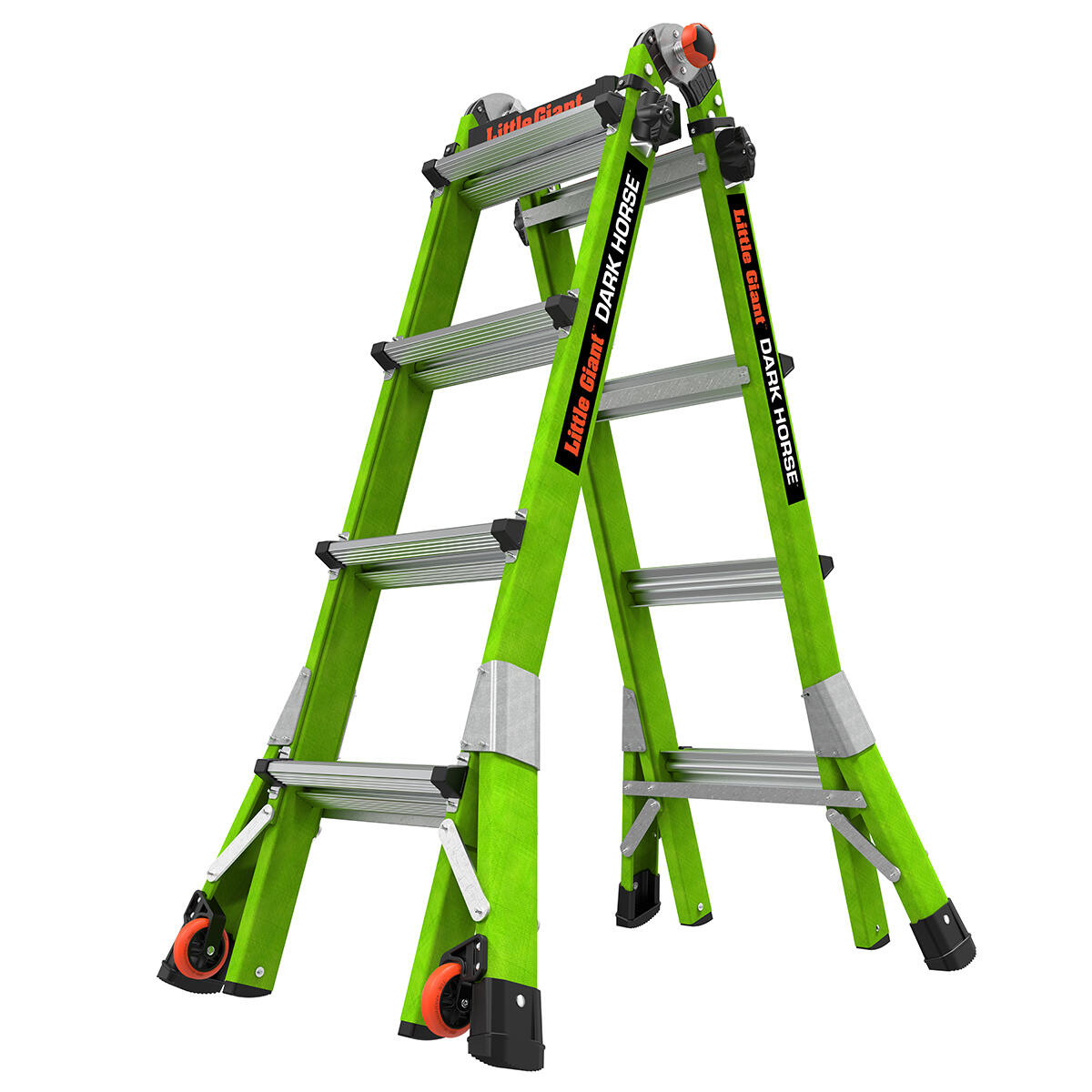
CSA duty ratings: understanding certification grades
The CSA Z11 standard defines a system of duty ratings (grades) that indicates the maximum load a ladder can safely support in normal use. This load includes the user's weight, clothing, tools and any equipment carried.
| CSA Grade | Equivalent ANSI Type | Maximum Load | Use | Level |
|---|---|---|---|---|
| Grade 1AA | Type IAA | 170 kg (375 lb) | Heavy industrial, harnesses, MRO | ⭐⭐⭐⭐⭐ |
| Grade 1A | Type IA | 136 kg (300 lb) | Professional, general construction | ⭐⭐⭐⭐ |
| Grade 1 | Type I | 113 kg (250 lb) | General industrial use | ⭐⭐⭐ |
| Grade 2 | Type II | 102 kg (225 lb) | Light commercial | ⭐⭐ |
| Grade 3 | Type III | 91 kg (200 lb) | Household use only | ⭐ |
For any professional use, Echelle Canada recommends Grade 1A at minimum. Grade 1AA is recommended for crews working with heavy equipment, safety harnesses or in demanding industrial environments. Never use a Grade 2 or 3 ladder in a professional setting: load capacity may be insufficient and regulatory compliance is not guaranteed.
What the CSA Z11 standard actually requires
Manufacturing
Structural components (rails, rungs, hinges) must pass static and dynamic load tests with thresholds defined by grade. Materials must meet minimum specifications for strength, ductility and durability. These tests are carried out by accredited certification bodies independent of the manufacturer.
Marking
Every CSA compliant ladder must permanently and legibly display: the duty rating, the load capacity in kilograms and pounds, the required safety warnings and the usage instructions. CSA marking on a ladder means the product has been tested and certified by an accredited body, not simply declared compliant by the manufacturer.
Use
The standard also sets out the good practices the manufacturer must communicate to the user: required setup angle (4:1 ratio for straight ladders), maximum climbing height allowed, and usage restrictions (do not lean beyond the side rails, do not allow two people on a ladder designed for one user, and so on).
CSA Z11 and ANSI standards: what the difference means for the Canadian market
In Canada, products must meet the CSA Z11 standard, published by the Canadian Standards Association. In the United States, the equivalent standards are the ANSI A14 series (A14.1 for wood, A14.2 for metal, A14.5 for fiberglass).
Most North American manufacturers design their products to meet both frameworks at once. A product marked CSA and ANSI has been tested to both standards. A product marked ANSI only, however, has not necessarily been CSA certified and should not be used in a Canadian professional setting without prior verification.
At Echelle Canada, we consistently indicate the CSA compliance of each product in our technical sheets. When a product is ANSI only, we flag it clearly: this is the case for some directly imported products for which CSA certification has not been obtained for the Canadian market.
Why CSA certification protects your business
Using CSA certified ladders in your workplace is not just good practice: it is a legal requirement in most Canadian provinces.
Occupational health and safety laws (LSST in Quebec, OHSA in Ontario) require that workplace equipment comply with applicable standards. If an accident involves a non compliant ladder, the employer can be held liable even if the accident did not result directly from a defect in the ladder.
CSA certification provides three concrete guarantees:
- A tested product: compliance has been verified by an accredited independent body, not just declared by the manufacturer.
- Traceability: certified products undergo regular factory inspections. If a manufacturing defect is identified, the manufacturer is required to report and correct it.
- Documented compliance: in the event of an audit or inspection, you can demonstrate the compliance of your equipment through the manufacturer's marking and documentation.
Our products compliant with the CSA Z11 standard
Grade 1AA, 170 kg (375 lb): heavy industrial use
- Featherlite, fiberglass: 6800-AA and 6600-AA stepladders; 6100 and 5600D single ladders; 9200D, 6200 and 6200D extension ladders.
- Little Giant, fiberglass: Dark Horse 2.0, King Kombo Industrial, MightyLite, Conquest, Sentinel.
Grade 1A, 136 kg (300 lb): professional use
- Featherlite, fiberglass: 6600, 6900 and 6400 (assembled in Canada) stepladders, 6500 and 6500-AA platform stepladders; 5300 single ladder.
- Featherlite, aluminum: 3400 stepladder; 4100 and 3100D single ladders; 4200D and 3200D extension ladders.
- Little Giant, fiberglass: King Kombo Pro, Technique, Flip-N-Lite, HyperLite.
All products listed above are CSA certified and available at Echelle Canada. Each product sheet indicates the applicable CSA grade.
Frequently asked questions about the CSA Z11 standard
Is the CSA Z11 standard mandatory in Canada?
Yes, in any professional context. Provincial occupational health and safety laws require equipment to comply with applicable standards. CSA Z11 is the reference standard for portable ladders in Canada. Failure to comply exposes the employer to legal liability in the event of an accident.
What is the difference between duty rating and load capacity?
These two terms describe the same thing: the maximum weight a ladder can safely support in normal use. This weight includes the user, their clothing, tools and any equipment carried. It is not a breaking weight but a normal use limit built with a safety margin.
Can an ANSI only ladder be used in Canada?
Technically, an ANSI ladder without CSA certification does not meet the requirements of the Canadian standard. In practice, ANSI and CSA standards are very close and some products comply with both without carrying both certifications. We recommend verifying explicit CSA certification before any professional purchase.
How do I verify that a ladder is CSA certified?
Look for the permanent CSA marking on the ladder (a plate or stamp), which indicates the duty rating, load capacity and standard number. Certified products carry the CSA logo. If in doubt, ask the supplier for the technical data sheet.
Do I need to replace my Grade 2 or 3 ladders in a professional setting?
Yes. Grade 2 and 3 duty ratings are designed for household use. Their load capacity and construction requirements are lower than what is required in a professional context. Using them in the workplace constitutes a regulatory non compliance.